
 Heather Stahl
The Time for Self-Improvement is Now
 Ryan Pleggenkuhle : May 09, 2023
Given the current state of banking, some financial institutions may be asking themselves: “What should we be doing right now to best prepare for the...

Note: This story also features insights from Rhonda Handy, VP, Risk and Compliance.
A newly announced savings opportunity aims to help families start saving for their child’s future earlier, with tax advantages designed specifically for kids. The program is scheduled to launch on July 5, 2026. As awareness of this new savings opportunity grows, families may turn to their financial institutions for clarity on how the accounts work, who qualifies and how they fit into an existing savings strategy. Clear, confident explanations will be essential to support informed financial decisions.
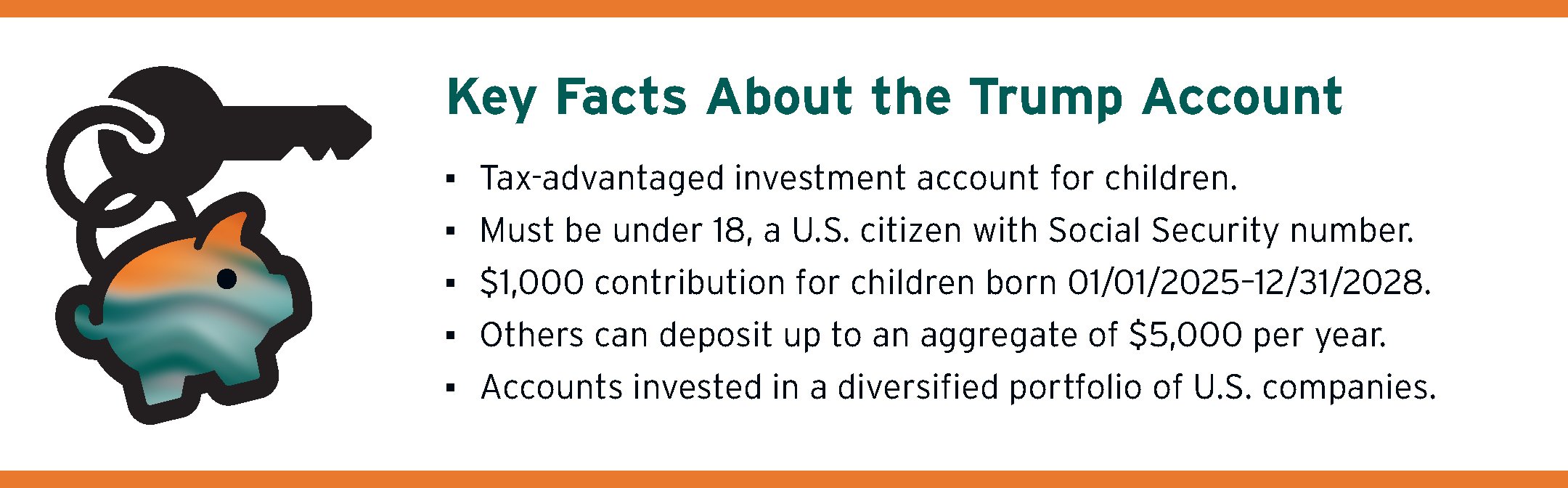
The “One Big Beautiful Bill Act” (OBBBA) established the Trump account as a long-term, tax-advantaged savings vehicle for the exclusive benefit of the eligible child. This account is designed to help eligible U.S. citizens under 18 build a financial foundation from birth. These accounts are similar to Individual Retirement Accounts (IRAs) but are specifically tailored for eligible minor children.
The Trump account also includes a pilot program for a one-time $1,000 government contribution to the qualified child’s account. This contribution is intended to help jump-start the child’s account.
Trump Account: The child must be under 18 and a U.S. citizen with a Social Security number. When the account is opened, the eligible child is the owner and the account beneficiary.
Pilot Program: To qualify for the one-time $1,000 government contribution, the child must be born between January 1, 2025 and December 31, 2028.
Yes. There are several types of contributions. A few include:
If the account does not qualify for the $1,000 contribution, the $5,000 maximum contribution for a calendar year still applies. Contributions cannot be made before July 4, 2026.
No. During the growth period (from the time the account is opened until the child turns 18), the funds will be invested in a diversified portfolio of low-cost index funds focused on American companies, designed to maximize long-term growth while minimizing risk.
How is the account opened?
To open a Trump account (and claim the $1,000 contribution, if applicable), families must do either of the following:
Account activation details are expected to be distributed starting in May 2026, with accounts officially going live on July 5, 2026.

Can we use the funds during the growth period?
No. Distributions will be allowed until the child turns 18. The money remains in the account during the growth period and can be transferred only in the event of a rollover from one institution to another (check trumpaccounts.gov for more updates, as this is still to be determined). After the growth period, starting on January 1st of the calendar year in which the child turns 18, the funds will be rolled over into a traditional IRA. At that time, withdrawals will be subject to standard traditional IRA rules.
According to trumpaccounts.gov, funds can be accessed without penalty once the child turns 18 for qualified purposes, such as education, buying a first home, or starting a business. However, withdrawals may be subject to restrictions and are generally taxed as ordinary income.
How is this different from a 529 or savings account?
While traditional savings accounts emphasize liquidity, 529 plans are limited to education expenses. Trump accounts are intended to be a more flexible, long-term, tax-advantaged option for a child’s future. Once they turn 18, they can keep the funds there to grow or withdraw them for expenses such as a down payment on a house, education, or to start a business.
Which is better: a 529 plan or the Trump account?
The better option depends on the goals for your child. If the primary focus is saving for college, you may be more interested in a 529 plan. However, a Trump account could be appealing because it allows you to start saving at birth and gives funds more time to grow.
Ultimately, the Trump account adds a new option to the list of savings tools available to families, offering early investment, tax advantages and flexibility for a child’s future goals. The intention is that they’ll learn about investing and watch their money grow. While it is not a replacement for education-focused plans like 529s or traditional savings vehicles, it may serve as a useful complement for families thinking long-term. As with any financial decision, it is important to help families understand the rules, tax implications and how the account fits into their broader planning goals.
Primary Sources:
https://www.savingforcollege.com/article/trump-account-tax-deferred-savings-children
https://www.irs.gov/pub/irs-drop/n-25-68.pdf
If you’d like to talk strategy or learn more about these accounts, reach out!

 Ryan Pleggenkuhle : May 09, 2023
Given the current state of banking, some financial institutions may be asking themselves: “What should we be doing right now to best prepare for the...
.jpg) Ryan Pleggenkuhle : July 18, 2025
Ryan Pleggenkuhle : July 18, 2025
Discover the 50-year journey of Mills Marketing, a leader in financial marketing, from its serendipitous beginnings to becoming a top-tier resource...
_Page_1-1.jpg)
 Brooke Von Ehwegen : October 06, 2026
Discover the key differences between Canva and Adobe Express to find the ideal design tool for your team’s needs and creative projects.